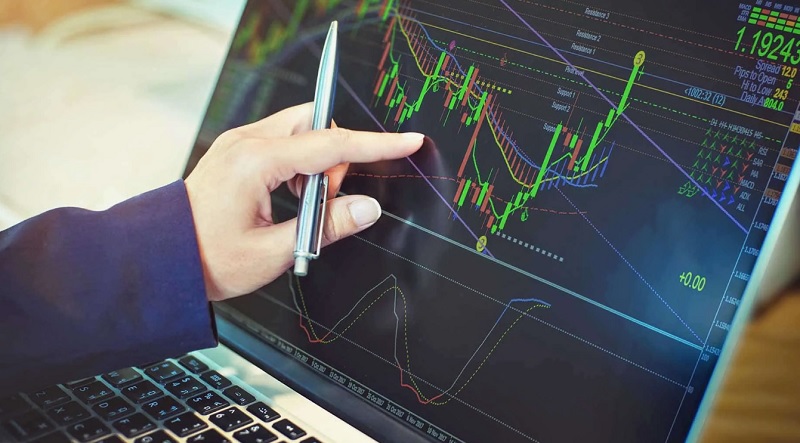
Is it worth trading with the VertexGate broker and who is the platform suitable for?
Currently, trading is a highly accessible field where it is possible to earn substantial amounts of money. All that is required is to provide a correct forecast regarding the rise or fall in the value of a particular asset. To start trading, you will need a broker that offers a virtual platform and facilitates financial transactions. In this article, we will provide a detailed VertexGate reviews and analyze the global prospects of trading.It is important to note in advance that trading does not require a large financial capital — you can start with small amounts. The technical process is simple and involves just a few steps.
How the VertexGate broker works
The company has achieved a wide coverage of various assets, offering the opportunity to trade both on the classic Forex market and to take advantage of innovative options. The full list of supported assets includes:
- Currency pairs,
- Cryptocurrencies,
- Indices,
- Commodities,
- Stocks,
- Securities.
Thus, if you are interested in trading, you will easily find a suitable option here. All the user needs to do is register, verify their account, make a deposit, and start trading. If any questions arise, the customer support team is available to assist.
Advantages of VertexGate broker
First and foremost, the platform features a simple interface that is easy to adapt to in just a few minutes. Even beginners can quickly understand the basics of trading and start earning money without lengthy training. There is no need to install additional software — all the necessary tools are available on the platform.
Another important aspect is the large number of analytical tools. The broker ensures that users can access all popular indicators that help predict asset movements. There is no need to download or install additional indicators elsewhere — any new tools are promptly integrated into the platform. Fans of technical analysis can confidently move to VertexGate.
For beginners, there is a wide range of educational materials available, aimed at teaching the basics of trading and improving skills. Full access to these materials is available with a premium account. Additionally, the broker organizes webinars discussing current events and their impact on the market. Overall, it is beneficial to progress beyond the beginner level and upgrade your account status to improve your trading results.
When to start trading on VertexGate
In practice, trading can become either a main occupation or a secondary source of income. It does not necessarily require a lot of time since the process can be automated by setting certain parameters. Most commonly, the following individuals engage in trading:
- Professional traders,
- Investors,
- Fans of mathematical strategies,
- Economists and financial sector experts.
If you belong to one of these categories, you can certainly try your hand at trading. VertexGate is an ideal choice thanks to its simplicity and wide range of supported assets. To trade, simply log into the platform and make a forecast. For example, if you believe the US dollar will fall against the Euro, navigate to the relevant currency pair and set this parameter. To minimize risks, establish acceptable growth limits for the asset and fix potential profits by marking the expected drop on the chart.
Asset categories cnalysis for Trading
When choosing an asset, it is important to consider its advantages and disadvantages, as well as current market trends. Based on the overall picture, the following characteristics can be highlighted:
Cryptocurrencies
Pros: High volatility allows quick earnings.
Cons: High volatility also means rapid losses; the market is poorly regulated.
Best for: Those willing to take risks and prefer active trading.
Stocks
Pros: Options range from stable «blue chips» to riskier companies; lots of available analysis.
Cons: The stock market can sometimes be sluggish or heavily influenced by macroeconomics.
Best for: Those looking for long-term prospects or moderate active trading.
Currency Pairs (Forex)
Pros: Huge liquidity, trading almost around the clock.
Cons: Requires a strong understanding of the global economy and leverage management skills.
Best for: Those who prefer active daily trading and quick decision-making.
Commodities (Gold, Oil, Gas)
Pros: Often used as «safe haven» assets (e.g., gold during crises).
Cons: Highly dependent on geopolitics and seasonality.
Best for: Those seeking diversification and inflation protection.
Indices (S&P 500, DAX, Nasdaq, etc.)
Pros: Lower risk compared to individual stocks, reflect the state of an entire market.
Cons: May move slower compared to individual stocks or cryptocurrencies.
Best for: Those looking for more stable growth and broad diversification.
Recommendations for beginners
New traders often rush to earn large profits and therefore make serious mistakes. If you have been trading for less than six months, it is advisable to follow these guidelines to protect your capital and learn the fundamentals:
First, choose one trading niche for a start.
Do not attempt to trade cryptocurrencies, forex, stocks, and commodities all at once. Focus on one area, such as just currency pairs or the top 10 stocks. This reduces confusion and makes it easier to spot patterns.
Second, practice on a demo account.
Open a demo account and trade with virtual money. Set tasks like achieving X% monthly profit or limiting losses to Y% per trade. This way, you practice without risking real money and develop trading discipline.
Third, trade according to a plan, not emotions.
Before every trade, ask yourself:
- Why am I entering this trade?
- Where is my stop-loss?
- Where is my take-profit?
Emotions are a trader’s biggest enemy — the plan is your shield.
Fourth, minimize risks.
Never risk more than 1–2% of your deposit on a single trade. This ensures that even a series of losses won’t wipe out your account.
Fifth, learn the basics of analysis.
Study at least basic technical analysis (charts, support/resistance levels) and fundamental analysis (economic news, company reports, inflation). The market is not a casino — understanding patterns gives you an advantage.
Sixth, keep a trading journal.
Record every trade:
- What worked,
- What went wrong,
- The reasons for success or failure.
- Reviewing your trades helps identify mistakes and refine your strategy.
Finally, don’t chase quick profits. It is better to grow slowly than lose your deposit quickly. True professionals are satisfied with 10–20% profit per month. Remember, trading is a marathon, not a sprint.
How much capital is needed to start
At the initial stage, a starting capital between 300 and 1000 USD is sufficient. This is enough to practice on the real market without risking large sums. With 300 dollars, you can work with micro-lots on Forex or purchase small shares of stocks. Starting with 500 to 1000 dollars provides more opportunities for diversifying trades, managing risks effectively, and achieving more noticeable results.
It is also possible to succeed with as little as 100 dollars, although this requires achieving positive results quickly. Ideally, you should enter trades during clear upward or downward trends. If the situation remains stable, a 100-dollar investment can quickly grow to 300, 500, or more. Thus, even with a small capital, significant profits are possible — much depends on market conditions and your ability to foresee upcoming events.
26.04.2025, 18:37
